
Book Review – The Coddling of the American Mind
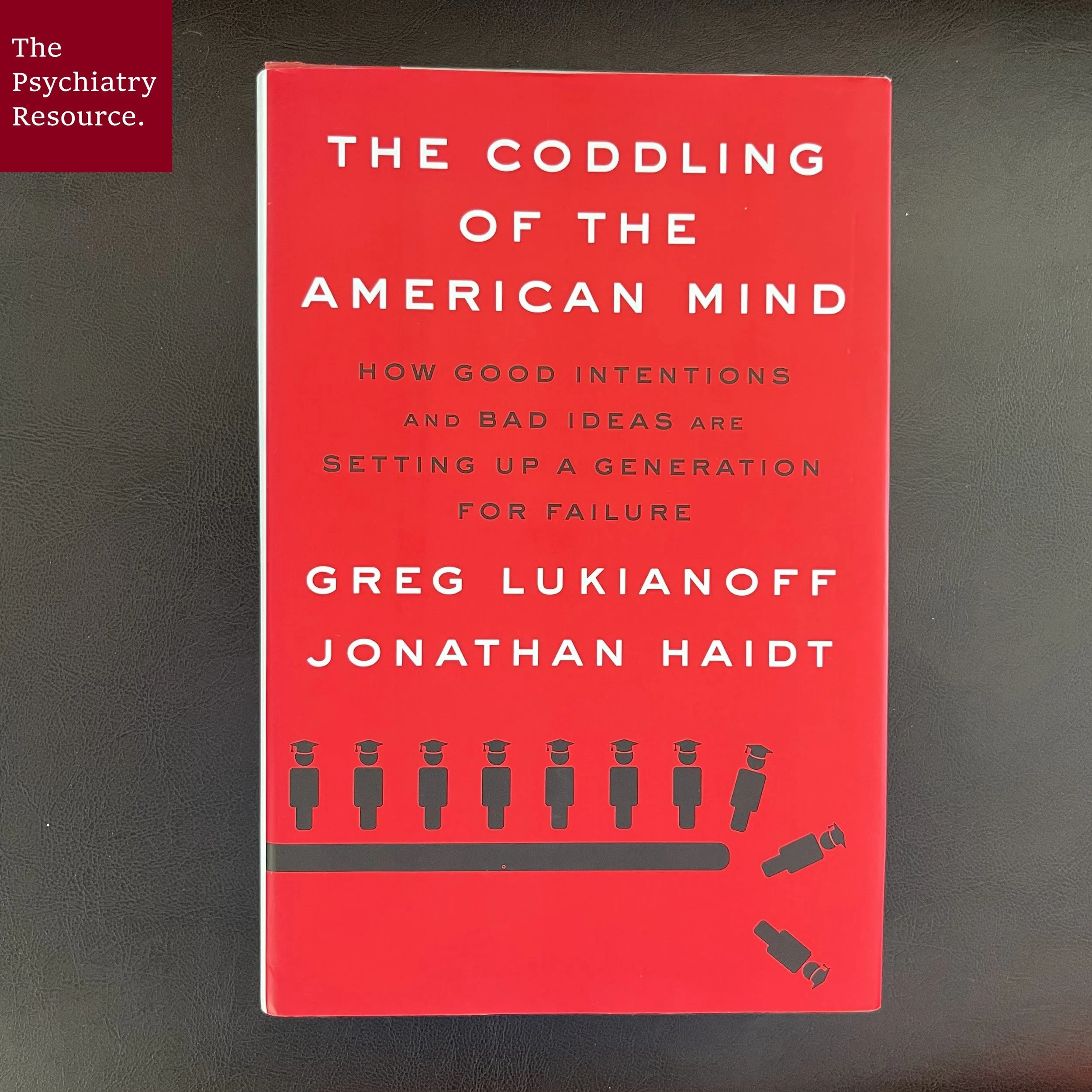
Image: The Coddling of the American Mind by Len Lantz (CC BY-NC-ND)
Synopsis: Len's Star Rating: 10 out of 10. An exceptional book on developing resilience in young people and reversing the trend of polarization in our communities, especially on college campuses.
BY LEN LANTZ, MD / 2.2.2026; No. 138
Disclaimer: Yes, I am a physician, but I’m not your doctor, and this article does not create a doctor-patient relationship. This article is for educational purposes and should not be seen as medical advice. You should consult with your physician before you rely on this information. This post also contains affiliate links. Please click this LINK for the full disclaimer.
Star Rating – 10 out of 10
Rating guide: 1 = horrible, 5 = average and 10 = wow
Authors
Greg Lukianoff and Jonathan Haidt
About the authors
Greg Lukianoff is a First Amendment attorney, writer, free speech advocate, and the CEO of the Foundation for Individual Rights and Expression (FIRE), a nonprofit focused on free speech, due process, and academic freedom. He earned his BA at American University and his JD at Stanford University. Greg Lukianoff coined the term “Weimar Fallacy” when debunking the idea that freedom of speech caused the horrors of Nazi Germany and the Holocaust. He has authored or co-authored several books on free speech, is a columnist for The Huffington Post, and serves as an expert and guest contributor to many national news organizations.
Jonathan Haidt, PhD, is an acclaimed social psychologist, writer, professor, and researcher of moral psychology. He is the co-developer of Moral Foundations theory. He has authored or co-authored several New York Times bestsellers. He earned his BA in Philosophy at Yale University and his master’s degree and PhD in Psychology from the University of Pennsylvania. Dr. Haidt taught at the University of Virginia for 16 years and, since 2011, has taught at New York University's Stern School of Business as the Thomas Cooley Professor of Ethical Leadership. Jonathan Haidt founded Heterodox Academy (a nonpartisan education membership organization that promotes viewpoint diversity) and Ethical Systems (an organization that helps businesses measure and improve corporate culture), and he co-founded the Constructive Dialogue Institute, which is a nonpartisan nonprofit that helps individuals and institutions gain communication skills to diffuse polarization and foster civil dialogue. He is a prolific writer in the popular press and has published over a hundred academic research papers. His newsletter is After Babel.
General description
The Coddling of the American Mind is a New York Times bestselling book written to combat three Great Untruths that are increasing and harming society:
The Untruth of Fragility: “What doesn’t kill you makes you weaker.”
The Untruth of Emotional Reasoning: “Always trust your feelings.”
The Untruth of Us Versus Them: “Life is a battle between good people and evil people.”
Authors Greg Lukianoff and Jonathan Haidt highlight that hostility toward alternative viewpoints has been growing across the US and the world, and that cultural shifts resulting in the repression of free speech have occurred most notably on college campuses. The authors explore reasons for these cultural changes, including educational institutions that foster cognitive distortions and tribalism, as well as overprotective parenting strategies. The Coddling of the American Mind offers strategies to help the reader (and the young people in their lives) become emotionally grounded, intellectually antifragile, and fearless of the viewpoints of people they disagree with. Topics covered in this book include:
The fallacy that words are “sources of danger”
The pitfalls of campus speech codes
The backfiring of attempts to prevent “triggering” or ensure “feeling safe” from disagreeable concepts or ideas
The harm in treating college students as fragile (the “fragile student model”)
The disunification caused by “call out” culture and “vindictive protectiveness”
Unique and most important aspects
The Coddling of the American Mind is one of the most insightful books on free speech published in the last decade. Authors Greg Lukianoff and Jonathan Haidt provide layer upon layer of valuable ideas and strategies for addressing the problems they discuss. The “coddling” in the book’s title refers to the general overprotectiveness of parents and college administrators toward youth. The authors show how well-meaning efforts to protect youth have gone overboard and, unfortunately, have led young people to become more anxious, unhappier, and less resilient. The concept of safety has gradually expanded on many college campuses to include “emotional safety,” and some administrators have attempted to control it by suppressing free speech. The Coddling of the American Mind shows why the culture of “safetyism” makes young people less safe. Important features of this book include:
Explaining the harm caused by the “heckler’s veto” (protesting in a way that prevents others from hearing a speaker)
Developing criteria to identify and classify an idea as a Great Untruth
“It contradicts ancient wisdom”
“It contradicts modern psychological research on well-being”
“It harms the individuals and communities who embrace it”
Listing and describing the nine most common cognitive distortions that result in emotional, cognitive, and social fragility
Arguing that the concept of “microaggressions” is fueled by cognitive distortions
Promoting the “principle of charity” in communicating with others
Showing how the bipolar dimensions of Intersectionality theory can increase tribalism
Contrasting common-humanity identity politics and common-enemy identity politics
Describing the four drivers of “negative partisanship” and “affective polarization” in US society
Exposing the problem of Turning Point USA’s “Professor Watchlist”
Sharing how to foster “experience-expectant development” by giving kids plenty of free play
Analyzing six “explanatory threads” that account for the cultural shifts seen on college campuses
Reviewing the interplay of intuitive justice, distributive justice, and procedural justice concepts
Providing six principles/advice for parents
“Prepare the Child for the Road, Not the Road for the Child”
“Your Worst Enemy Cannot Harm You as Much as Your Own Thoughts, Unguarded”
“The Line Dividing Good and Evil Cuts Through the Heart of Every Human Being”
“Help Schools to Oppose the Great Untruths”
“Limit and Refine Device Time”
“Support a New National Norm: Service or Work Before College”
Best quotes
“What is new today is the premise that students are fragile.”
“Stated simply: Many university students are learning to think in distorted ways, and this increases their likelihood of becoming fragile, anxious, and easily hurt.”
“But gradually, in the twenty-first century, on some college campuses, the meaning of ‘safety’ underwent a process of ‘concept creep’ and expanded to include ‘emotional safety.’”
“These experiences are sad and painful, but pain is not the same thing as trauma.”
“But young adults are not flickering candle flames. They are antifragile, and that is true even of victims of violence and those who suffer from PTSD… Avoiding triggers is a symptom of PTSD, not a treatment for it.”
“Safetyism is the cult of safety—an obsession with eliminating threats (both real and imagined) to the point at which people become unwilling to make reasonable trade-offs demanded by other practical and moral concerns.”
“There is a principle in philosophy and rhetoric called the principle of charity, which says that one should interpret other people’s statements in their best, most reasonable form, not in the worst or most offensive way possible.”
“These interpretations of intersectionality teach people to see bipolar dimensions of privilege and oppression as ubiquitous in social interactions.”
“If we want to create welcoming, inclusive communities, we should be doing everything we can to turn down the tribalism and turn up the sense of common humanity.”
“Common-enemy identity politics, when combined with microaggression theory, produces a call-out culture in which almost anything one says or does could result in a public shaming.”
“But if you keep the distinction between speech and violence clear in your mind, then many more options are available to you.”
“This is why quotas generally produce such a strong backlash: they mandate a violation of procedural justice (people are treated differently based on their race, sex, or some other factor) and distributive justice (rewards are not proportional to inputs) to achieve a specific end-state of equal outcomes.”
Who would enjoy this book?
Readers interested in learning about the causes of increased polarization in society and strategies both for addressing the schism and increasing resilience for themselves and young people are likely to enjoy The Coddling of the American Mind.
Who would not enjoy this book?
Readers who are adherent to the three Great Untruths or who want free speech for themselves and not for others are unlikely to enjoy The Coddling of the American Mind.
Conclusion
The Coddling of the American Mind is an exceptional book on developing resilience in young people and reversing the trend of polarization in our communities, especially on college campuses.