
Book Review – Factfulness
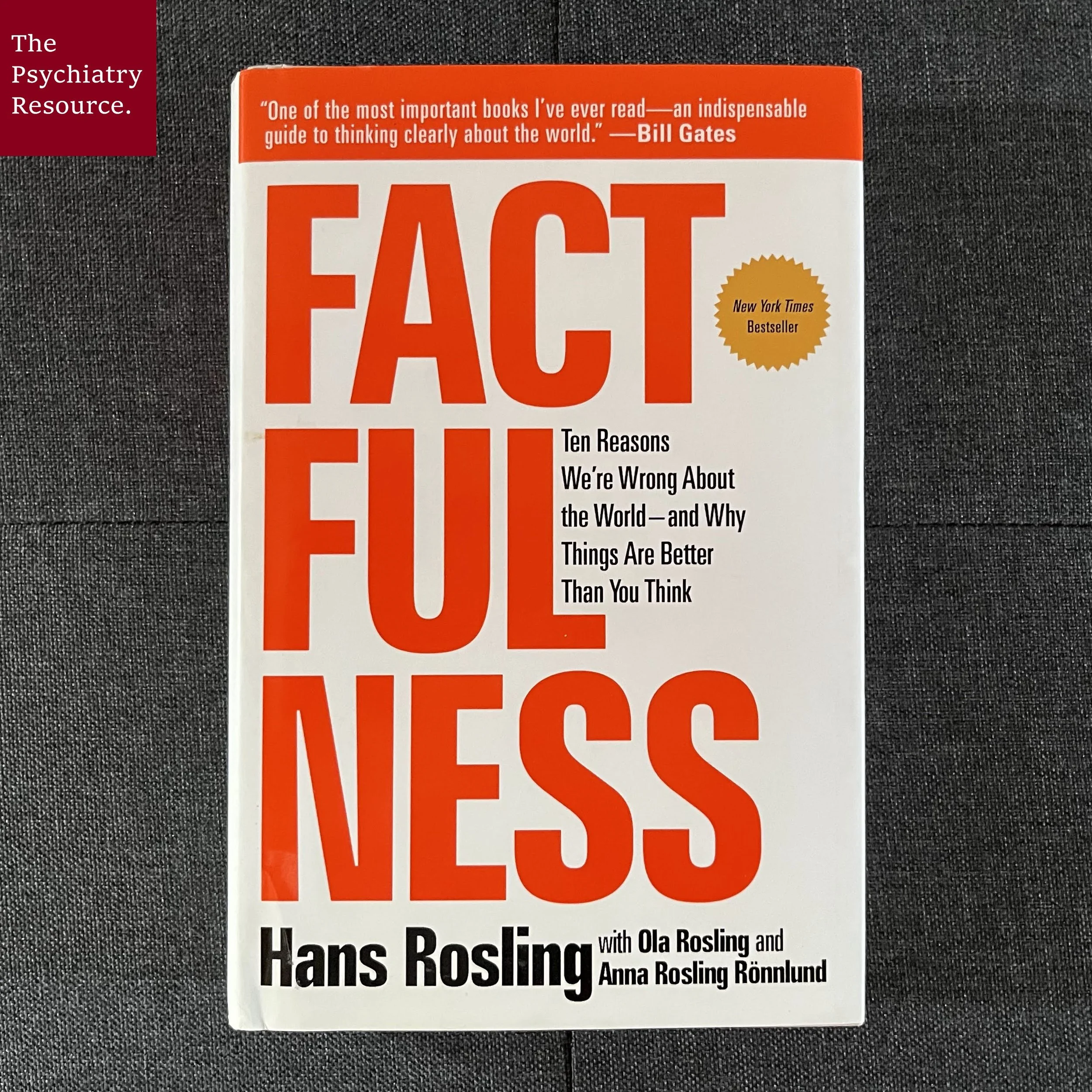
Image: Factfulness by Len Lantz (CC BY-NC-ND)
Synopsis: Len's Star Rating: 9 out of 10. An excellent book on developing an accurate, data-driven worldview.
BY LEN LANTZ, MD / 2.1.2026; No. 137
Disclaimer: Yes, I am a physician, but I’m not your doctor, and this article does not create a doctor-patient relationship. This article is for educational purposes and should not be seen as medical advice. You should consult with your physician before you rely on this information. This post also contains affiliate links. Please click this LINK for the full disclaimer.
Star Rating – 9 out of 10
Rating guide: 1 = horrible, 5 = average and 10 = wow
Authors
Hans Rosling, Ola Rosling, and Anna Rosling Rönnlund
About the authors
Hans Rosling (1948–2017) was a Swedish physician, public speaker, researcher, and professor. He earned his medical degree from Uppsala University and studied public health at St. John's Medical College (Bangalore, India). After working in Africa for 20 years studying and treating infectious diseases, he returned to Sweden, where he earned a PhD at Uppsala University and taught international health at the Karolinska Institute. Dr. Rosling was co-founder and chairman of the Gapminder Foundation, which developed a software system (Trendalyzer) that converts statistics into easy-to-understand animated graphics. He excelled at making abstract concepts concrete. Hans Rosling was a captivating speaker, even swallowing a sword at the end of one of his TED Talks. In 2012, he was included in Time’s list of the world's 100 most influential people. His book, Factfulness, co-authored by his son, Ola Rosling, and his daughter-in-law, Anna Rosling Rönnlund, was published posthumously in 2018.
Ola Rosling is the President and co-founder of the Gapminder Foundation. He led the development of the Trendalyzer software (acquired by Google in 2007) and worked at Google on the Motion Chart (Google Spreadsheets) and other projects before returning to Gapminder in 2011. Ola Rosling is credited with coining the term Factfulness, an approach that shifts the focus of sustainable development education from ideology to a fact-based worldview. In 2013, he launched the Ignorance Project to measure the public’s lack of global factual knowledge and identify the most neglected statistics.
Anna Rosling Rönnlund co-founded Gapminder together with her father-in-law, Hans Rosling, and husband, Ola Rosling. She earned her BA in Photography at the University of Gothenburg and her master’s degree in sociology at Lund University. She was instrumental in developing the Trendalyzer software system and worked on the Motion Chart and other projects at Google after it acquired Trendalyzer in 2007. Anna Rosling Rönnlund returned to Gapminder in 2010, where she serves as Vice President and Head of Design & User Experience. She also founded Dollar Street, a repository of photos and video clips combined with income levels, which shows surprising commonalities among people living on similar incomes in different countries and striking differences in how people live (at various income levels) within the same country.
General description
Factfulness is a New York Times bestselling book that provides readers with practical tools for understanding the world better. The authors’ goal is to overcome an “overdramatic worldview” driven by 10 dramatic instincts, or Mega Misconceptions. While fears fueled by the media often lead to an “us versus them” worldview, Factfulness provides surprising and refreshing data on aspects of the world that are actually improving. A “Factfulness” section at the end of each chapter offers strategies to combat common, incorrect instincts or misconceptions. Topics covered in this book include:
Listing numerous areas of progress and improvements in the world, and providing the data to prove it
Debunking the outdated and incorrect categorization of countries into developing or developed
Describing the Four Income Levels with data and pictures
Providing projections of population changes in 2100
Outlining the “Five Global Risks We Should Worry About”
Global Pandemic
Financial Collapse
World War III
Climate Change
Extreme Poverty
Unique and most important aspects
I enjoyed reading Factfulness and learning about characteristics of the world I was unaware of, especially statistics on population growth, population shifts, economic improvements, and health improvements. The book does not paint an overly rosy picture, but rather an accurate one.
One of the main arguments of the book is that the old idea of developed vs. developing nations, prevalent in 1965, has been inaccurate for decades. Instead of dividing the world into two groups, the authors persuasively argue that it is better understood when categorized into Four Income Levels.
The authors clearly and effectively delivered on the book's subtitle, Ten Reasons We’re Wrong About the World—and Why Things are Better Than You Think. In an era of increasing polarization and biased reporting, the authors provide an antidote to our preexisting biases and cognitive errors. They also included a “Factfulness Rules of Thumb” that distilled the book's main points onto one page.
Of note, I disagreed with the authors’ sweeping overgeneralization that US physicians “spend time that could be used to save lives or treat illness providing unnecessary, meaningless care.” Perhaps the authors should have taken their own advice when they stated, “In fact, resist blaming any one individual or group of individuals for anything. Because the problem is that when we identify the bad guy, we are done thinking. And it’s almost always more complicated than that. It’s almost always about multiple interacting causes—a system.”
Essential features of this book include:
Contrasting “extreme poverty” and “relative poverty”
Sharing “The PIN Code of the World” (an easy way to recall population numbers geographically, in billions)
Present day: 1-1-1-4 (Americas: 1, Europe: 1, Africa: 1, Asia: 4)
In 2100: 1-1-4-5 (Americas: 1, Europe: 1, Africa: 4, Asia: 5)
Defining and explaining the “Dramatic Instincts” (cognitive errors as they relate to worldview)
Gap Instinct: creates an us-versus-them mentality
Negativity Instinct: interferes with seeing actual improvements
Straight Line Instinct: leads one to believe that problems will continue until a collapse
Fear Instinct: equates fear with danger rather than looking at the data
Size Instinct: causes failure to make correct judgments based on actual proportions
Generalization Instinct: generates incorrect conclusions from flawed categorizations
Destiny Instinct: fosters negativism and blinds people to the fact that slow change is still change
Single Perspective Instinct: limits creativity in generating solutions to complex problems
Blame Instinct: focuses on villains and scapegoats rather than understanding root causes and creating systemic change
Urgency Instinct: stimulates people to act rashly, which could result in tragic consequences (despite having good intentions)
Best quotes
“The rich are getting richer and the poor are getting poorer; and the number of poor just keeps increasing; and we will soon run out of resources unless we do something drastic. At least that’s the picture that most Westerners see in the media and carry around in their heads. I call it the overdramatic worldview. It’s stressful and misleading.”
“[The child mortality rate] doesn’t just tell us about the health of children. It measures the quality of the whole society.”
“Culture and freedom, the goals of development, can be hard to measure, but guitars per capita is a good proxy.”
“People often call me an optimist, because I show them the enormous progress they didn’t know about. That makes me angry. I’m not an optimist. That makes me sound naïve. I’m a very serious ‘possibilist.’”
“I am certainly not advocating looking away from the terrible problems in the world. I am saying that things can be both bad and better.”
“When you hear about something terrible, calm yourself by asking, If there had been an equally large positive improvement, would I have heard about that? Even if there had been hundreds of larger improvements, would I have heard? Would I ever hear about children who don’t drown?”
“The UN experts are not predicting that the number of children will stop increasing. They are reporting that it is already happening. The radical change that is needed to stop rapid population growth is that the number of children stops growing. And that is already happening.”
“We should do everything we can to reduce child mortality, not only as an act of humanity for living suffering children but to benefit the whole world now and in the future.”
“There’s no room for facts when our minds are occupied by fear.”
“The safest lives in history are lived today by people on Level 4. Most preventable risks have been eliminated. Still, many walk around feeling worried.”
“Be cautious about generalizing from Level 4 experiences to the rest of the world. Especially if it leads you to the conclusion that other people are idiots.”
“Slow change is not no change.”
“To understand most of the world’s significant problems we have to look beyond a guilty individual and to the system.”
“Exaggeration, once discovered, makes people tune out altogether.”
Who would enjoy this book?
Readers interested in a book that explains cognitive errors and provides tools for developing an accurate worldview are likely to enjoy Factfulness.
Who would not enjoy this book?
Readers interested in a book based on ideology rather than a data-driven worldview are unlikely to enjoy Factfulness.
Conclusion
Factfulness is an excellent book on developing an accurate, data-driven worldview.