
Book Review – A First-Rate Madness
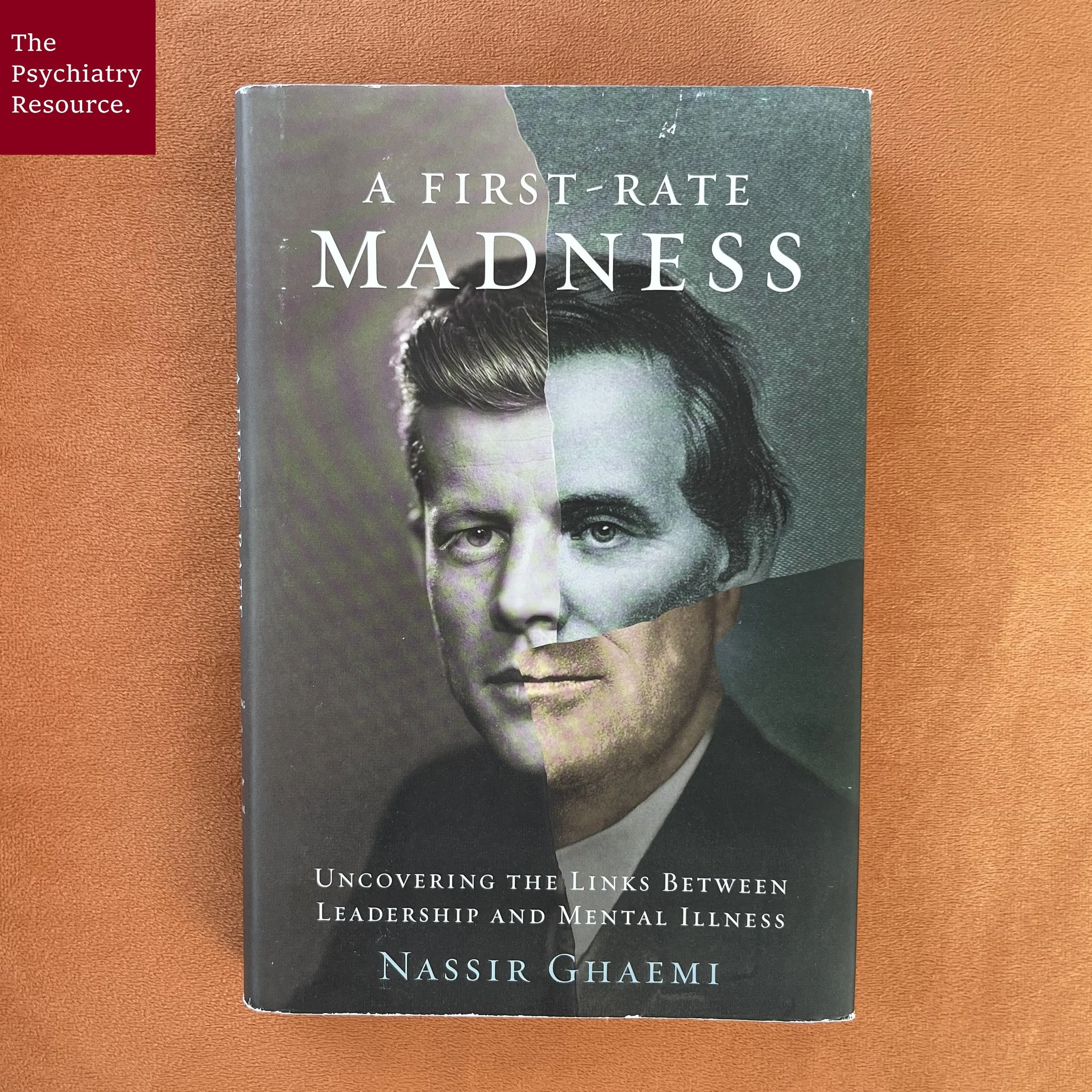
Image: A First-Rate Madness by Len Lantz (CC BY-NC-ND)
Synopsis: Len's Star Rating: 10 out of 10. A fascinating and unconventional book on leadership and mental illness.
BY LEN LANTZ, MD / 12.19.2025; No. 135
Disclaimer: Yes, I am a physician, but I’m not your doctor, and this article does not create a doctor-patient relationship. This article is for educational purposes and should not be seen as medical advice. You should consult with your physician before you rely on this information. This post also contains affiliate links. Please click this LINK for the full disclaimer.
Star Rating – 10 out of 10
Rating guide: 1 = horrible, 5 = average and 10 = wow
Author
Nassir Ghaemi
About the author
Nassir Ghaemi, MD, is a psychiatrist, writer, teacher, and researcher with a focus on depression and bipolar disorder. He has written and edited several books on psychiatry and published hundreds of academic articles. He earned his BA in history from George Mason University and his MD from the Medical College of Virginia. He completed his psychiatry residency at Harvard’s McLean Hospital. He also earned an MA in philosophy from Tufts University and an MPH from the Harvard School of Public Health. Dr. Ghaemi is a professor of psychiatry at Tufts University and a lecturer in psychiatry at Harvard Medical School. He also serves as the Director of the Mood Disorder Program and the Psychopharmacology Consultation Clinic at Tufts Medical Center.
General description
A First-Rate Madness is a New York Times bestselling book that explores mental illness as an asset in specific leadership settings. In this contrarian and enlightening exploration of mental health and leadership, Dr. Nassir Ghaemi shows how mental illness was adaptive for several well-known and highly effective leaders, which he contrasts with the poor outcomes of mentally healthy leaders who failed in times of crisis. The author states, “One might call it the Inverse Law of Sanity: when times are good, when peace reigns, and the ship of state only needs to sail straight, mentally healthy people function well as our leaders. When our world is in tumult, mentally ill leaders function best.” A First-Rate Madness shows how conditions present in mood disorders, such as empathy, creativity, realism, and resilience, are essential attributes for leaders to display in times of crisis. Dr. Ghaemi calls his approach to famous figures, such as Lincoln, Gandhi, Churchill, FDR, JFK, and Martin Luther King, "psychological history," as he seeks to transcend stigma and truly understand these and other leaders rather than pathologize them.
Unique and most important aspects
A First-Rate Madness offers a fresh, unconventional perspective filled with original ideas on leadership and mental illness. Author Nassir Ghaemi convincingly shows how mentally healthy leaders can falter in times of crisis, which is a time when mentally ill leaders can shine. While this thesis is counterintuitive and increasingly controversial in an era of worsening political polarization, the author’s premise is clearly worth considering.
While there is a risk of force-fitting historical figures into rigid categories, I found the author’s approach to this subject to be rational and scientific, not forced or ideological. It is uplifting and refreshing to have leaders in the field of psychiatry, like Dr. Ghaemi, write about positive attributes of mental illness. The chapters I found most enlightening and moving were chapter 8 (on MLK and empathy) and chapter 10 (on FDR and hyperthymic personality/temperament). Important concepts of this book include:
The importance of resilience and realism in leadership, not just creativity and empathy
The depressive realism hypothesis
Conclusions about the “positive illusion” effect in the mentally healthy
“The skew of happiness”
“The perils of success”
The Goldilocks principle in relation to positive illusions and mood disorders
Comparing and contrasting dysthymia, hyperthymia, and cyclothymia
Common aspects of people with hyperthymic personality
High on openness to experience: “they are curious, inventive, experimental souls”
Low on neuroticism
High on extraversion
How empathy involves the mirror neuron system of the brain
The concept of “ordinary magic” in psychological resilience
A biological explanation for the “Kennedy curse”
Defining “homoclite” leaders
The “Hubris syndrome” as a disorder of power
The “Eagleton effect”
Best quotes
“Depression makes leaders more realistic and empathic, and mania makes them more creative and resilient.”
“With these definitions, the theme of this book can be stated this way: The best crisis leaders are either mentally ill or mentally abnormal; the worst crisis leaders are mentally healthy.”
“Creativity may have to do less with solving problems than with finding the right problems to solve.”
“[Lincoln] did not bask in success; instead, he reached out to his enemies, tried to commune with them, presaging Martin Luther King’s advice that when your enemy is most vulnerable, when you could hurt him badly, that is when you must not do it.”
“Depression reveals the truth of empathy, and empathy, in turn, engenders unexpected powers of leadership.”
“King’s nonviolent movement was a cure for racism, not a political strategy. Like many treatments, it has healed rather than cured, leaving scars behind. It was a medical metaphor, a political psychiatry, based on the healing power of empathy.”
“The difference between agape and philia is why Jesus counseled us to love, not like, our enemies.”
“Thus as documented above, King’s nonviolence is not about being nonaggressive; it is about being aggressive in a nonviolent way.”
“Freud wrote an entire book about wit, and the psychoanalyst George Vaillant, in his classic fifty-year study of mental health, concluded that humor was the best hallmark of mental health.”
“There is post-traumatic growth: trauma itself might not harm some people psychologically at all; it might in fact help them. It is not a matter of getting better despite the trauma, but rather because of it.”
“Without intending to do so, we showed that past PTSD could, like a vaccine, protect against future PTSD.”
“Psychiatry may not be the solution when sanity—not illness—is the problem.”
“The medical and legal meanings of mental illness hardly overlap at all.”
“The thesis of this book runs counter to a deep cultural stigma accompanying mental illness.”
“However deep the stigma may be, the indisputable fact remains that the border between health and illness is porous.”
“Quite a paradox it is: being open to some depression may allow us, ultimately, to be less depressed.”
Who would enjoy this book?
Readers interested in learning more about past leaders with mental illness and how mental illness could be a leadership asset will likely enjoy A First-Rate Madness.
Who would not enjoy this book?
Readers who overgeneralize the thesis of the book are unlikely to enjoy A First-Rate Madness.
Conclusion
A First-Rate Madness is a fascinating and unconventional book on leadership and mental illness.